Why Does Domain Authority Differ Between Semrush and Moz? Explained
Why does Domain Authority differ between Semrush and Moz? Discover the key differences between Moz DA and Semrush Authority Score, including backlinks, traffic, algorithms, and ranking signals.
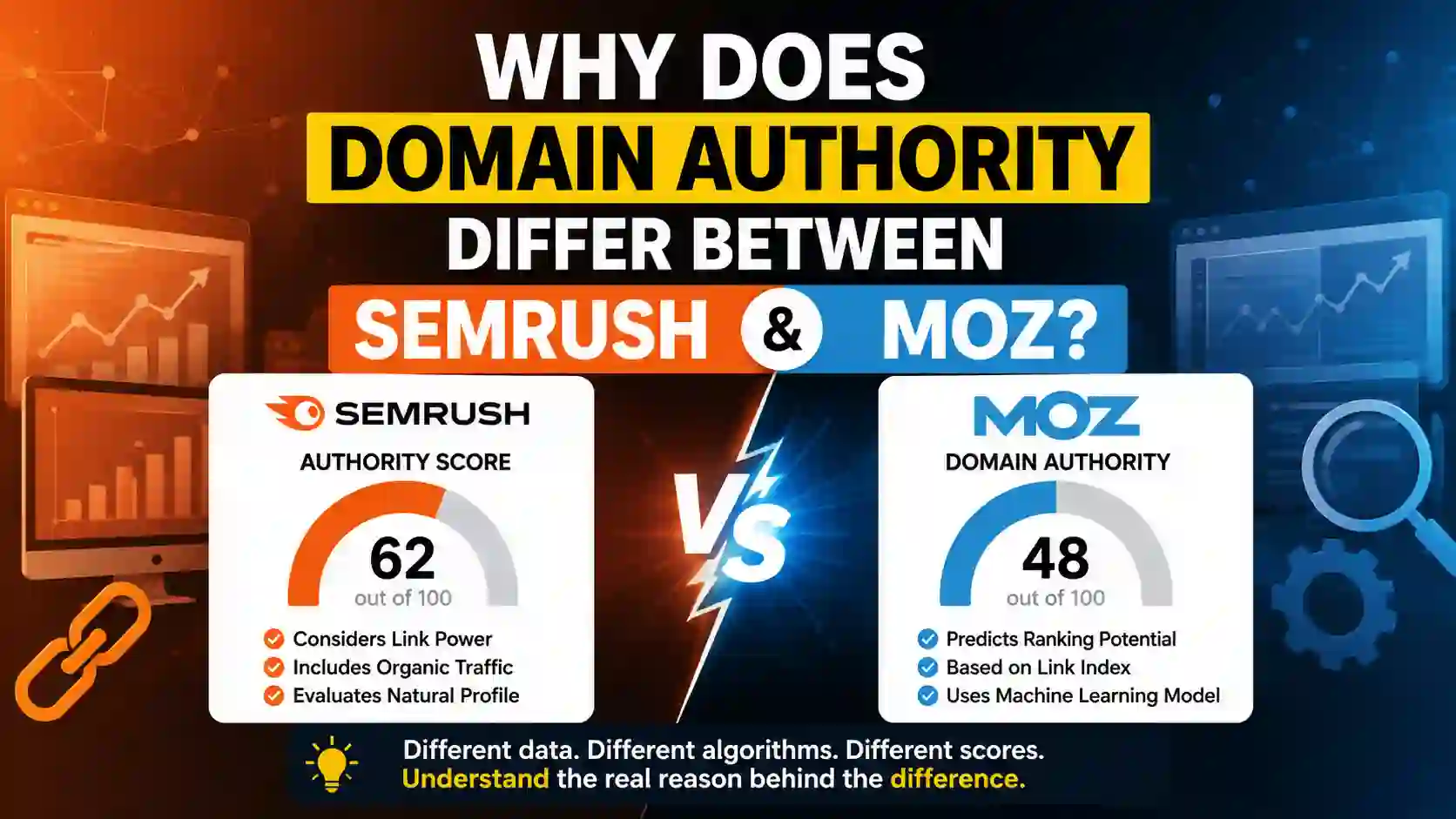
Why Does Domain Authority Differ Between Semrush and Moz? Complete Explanation
If you have ever checked your website in both Semrush and Moz, you may have noticed something confusing: the authority score shown by the two platforms can be very different. One tool may show a relatively high score while the other reports a much lower number. This often leads website owners, bloggers, SEO professionals, and digital marketers to ask, why does domain authority differ between semrush and moz?
The short answer is that Semrush and Moz do not use the same authority metric, backlink database, calculation method, or ranking model. Semrush primarily reports Authority Score, while Moz reports Domain Authority (DA). Although both metrics use a scale from 1 to 100 and attempt to estimate the strength of a website, they are not interchangeable.
Semrush's Authority Score combines backlink quality, estimated organic traffic, and signals associated with unnatural or manipulative link profiles. Moz's Domain Authority uses its own link index and a machine-learning model designed to predict how likely a domain is to rank in Google's search results.
This explains why does domain authority differ between semrush and moz even when you enter exactly the same website into both tools.
Understanding the difference is important because many website owners make the mistake of treating DA and Authority Score as if they were two versions of the same number. They are not. Instead, they are independent third-party SEO metrics that can be used for comparison, benchmarking, and monitoring SEO progress.
Quick Answer: Why Does Domain Authority Differ Between Semrush and Moz?
The primary reason why does domain authority differ between semrush and moz is that the two platforms evaluate websites using different systems.
Semrush calls its metric Authority Score, whereas Moz calls its metric Domain Authority.
Semrush Authority Score considers three major areas:
- Link Power
- Estimated Organic Traffic
- Natural Profile and spam-related signals
Semrush states that its Authority Score uses eight weighted factors, including backlink strength, organic traffic, lack of organic rankings, unusually high percentages of dofollow referring domains, unusual relationships between links and traffic, shared IP patterns, shared network patterns, and similar backlink profiles.
Moz Domain Authority is different. Moz describes DA as a predictive score that estimates how likely a website is to rank in search results. It uses data from Moz's link index and a machine-learning model.
Therefore, if Semrush gives your website an Authority Score of 45 and Moz gives it a DA of 62, this does not automatically mean that one tool is wrong.
It simply demonstrates why does domain authority differ between semrush and moz.
Important Information About Semrush Authority Score and Moz DA
| Metric | Semrush Authority Score | Moz Domain Authority |
|---|---|---|
| SEO Tool | Semrush | Moz |
| Scale | 1–100 | 1–100 |
| Main purpose | Estimate website authority and quality | Predict ranking strength |
| Backlinks considered | Yes | Yes |
| Organic traffic considered | Yes | Primarily a predictive/link-based model |
| Spam/manipulation signals | Yes | Uses its own modeling and link data |
| Machine learning | Used in Semrush's broader modeling | Core component of DA prediction |
| Google ranking factor | No | No |
| Can be compared directly? | No | No |
| Best use | Benchmarking and link evaluation | Comparing ranking potential |
| Database | Semrush's own index | Moz's own link index |
| Score meaning | Relative website strength | Relative ranking likelihood |
The table makes it easier to understand the fundamental difference. Why does domain authority differ between semrush and moz becomes much easier to answer once you realize that the numbers come from different models.
What Is Semrush Authority Score?
Semrush Authority Score is a proprietary metric designed to estimate the overall quality and authority of a website or webpage.
According to Semrush, the metric incorporates link power, organic traffic, and natural-profile signals. Link Power evaluates the quantity and quality of referring domains. Organic Traffic uses Semrush's estimated search traffic data. Natural Profile evaluates signals that may indicate manipulation or unnatural backlink patterns.
This is particularly important when analyzing websites for link-building.
For example, imagine two websites:
Website A
- 500 referring domains
- Strong backlinks
- Significant organic traffic
- Natural backlink profile
Website B
- 700 referring domains
- Very little organic traffic
- Extremely high percentage of dofollow links
- Several suspicious backlink patterns
A simple backlink-counting system might consider Website B stronger because it has more referring domains.
Semrush may not reach the same conclusion because Authority Score considers additional signals beyond backlink quantity.
This is one of the biggest reasons why does domain authority differ between semrush and moz.
Semrush's system is attempting to evaluate more than just how many websites link to a domain.
What Is Moz Domain Authority?
Domain Authority, commonly abbreviated as DA, was created by Moz to provide an estimate of a website's ability to rank in search engines.
Moz uses a scale from 1 to 100. Generally, higher scores indicate greater predicted ranking ability.
However, DA should not be interpreted as a score assigned by Google.
Moz's Domain Authority is a third-party SEO metric. Google does not publish a "Domain Authority" score for websites, and having a high DA does not directly cause a website to rank higher.
Moz's model uses information from its own link index and machine-learning technology to estimate ranking strength.
This difference in methodology is critical when answering why does domain authority differ between semrush and moz.
Moz is essentially asking:
Based on our data and model, how likely is this domain to rank?
Semrush is asking a somewhat different question:
Based on our backlink strength, estimated organic traffic, and natural-profile signals, how authoritative and trustworthy does this domain appear?
Those questions overlap, but they are not identical.
Different Backlink Databases
One of the biggest explanations for why does domain authority differ between semrush and moz is that Semrush and Moz maintain separate databases of backlinks.
The web is enormous. No SEO platform can discover every backlink on the internet at exactly the same time.
A backlink might be:
- Discovered by Semrush but not Moz
- Discovered by Moz but not Semrush
- Discovered by both but interpreted differently
- Removed from one database before the other
- Crawled at different times
- Classified differently by each platform
Suppose your website has 1,000 backlinks.
Semrush may have discovered 650 relevant links.
Moz may have discovered 800.
That difference alone can influence the resulting authority score.
The situation becomes even more complicated because not all backlinks carry the same value. One platform might consider a particular link more influential than another platform does.
Consequently, differences in backlink discovery and processing are a major part of why does domain authority differ between semrush and moz.
Different Definitions of a High-Quality Backlink
Another reason why does domain authority differ between semrush and moz is that the platforms do not necessarily assign identical value to every backlink.
Consider a link from a website with:
- High domain authority
- Low organic traffic
- Hundreds of outbound links
- Low topical relevance
Another website might have:
- Moderate authority
- Strong organic traffic
- High topical relevance
- A smaller number of outbound links
Different SEO platforms can interpret these relationships differently.
This means that having 100 backlinks does not guarantee that Semrush and Moz will assign exactly the same authority value to your domain.
The quality, source, context, relevance, and characteristics of those links all matter.
Semrush Also Considers Estimated Organic Traffic
This is one of the most important differences.
Semrush's Authority Score includes estimated organic traffic as one of its major components. Semrush explains that organic traffic is estimated from keyword rankings and the click potential associated with ranking positions.
This means that a website with a strong backlink profile but virtually no organic visibility may receive a different Authority Score than you might expect.
For example:
Website A
- 300 referring domains
- Strong backlinks
- 50,000 estimated organic visits per month
Website B
- 350 referring domains
- Similar backlink count
- 1,000 estimated organic visits per month
Depending on the overall profile, Semrush may treat Website A as stronger.
This is another important answer to why does domain authority differ between semrush and moz.
Moz's DA calculation is designed around predicting ranking ability using its own link data and machine-learning model, while Semrush explicitly incorporates estimated organic traffic into Authority Score.
Spam and Manipulation Signals Can Affect Semrush
Semrush also examines signals associated with potentially unnatural backlink profiles.
Its current documentation identifies several signals used within its Natural Profile component. These include having no organic rankings, an unusually high percentage of dofollow referring domains, an imbalance between backlinks and organic traffic, too many referring domains sharing an IP address, too many sharing an IP network, and the presence of another domain with an almost identical backlink profile.
Therefore, a website may have thousands of backlinks but still receive a lower Authority Score than expected.
For example, imagine a site has:
- 2,000 referring domains
- Very little organic traffic
- Almost entirely dofollow links
- Many referring domains hosted on similar networks
The raw backlink count looks impressive.
However, Semrush may interpret parts of that profile as suspicious.
This is another major factor behind why does domain authority differ between semrush and moz.
The Two Tools Use Different Algorithms
SEO metrics are not universal measurements.
Think of them like credit scores.
Different credit agencies can evaluate the same person and produce different numbers because they use different datasets, formulas, and scoring models.
The same principle applies to website authority.
Moz has its own algorithm.
Semrush has its own algorithm.
Ahrefs has another algorithm called Domain Rating.
Majestic has its own authority-related metrics.
None of these numbers is Google's official authority score.
Therefore, why does domain authority differ between semrush and moz is not really a problem that needs fixing. The difference is expected.
Why Your Scores Can Be Dramatically Different?
You may see situations such as:
- Semrush Authority Score: 25
- Moz DA: 42
Or:
- Semrush Authority Score: 58
- Moz DA: 71
Or even:
- Semrush Authority Score: 70
- Moz DA: 48
Large differences can happen because each platform's model is based on its own data and methodology.
A website with strong backlinks but weak estimated search traffic may perform differently in Semrush.
A website with a large number of links recognized by Moz may receive a stronger DA.
A website with rapidly changing backlinks may also show different scores because the platforms crawl and update their databases at different times.
This is why why does domain authority differ between semrush and moz is one of the most common questions among people comparing SEO tools.
Does a Higher Moz DA Mean the Website Is Better?
Not necessarily.
A high DA can be useful, but it should never be the only measurement of website quality.
Suppose Website A has:
- DA 60
- Poor content
- Very little traffic
- Low topical relevance
Website B has:
- DA 40
- Excellent content
- Strong topical relevance
- High conversion rate
- Growing organic traffic
Website B could be a much better website for your particular purpose.
DA is primarily useful as a comparative metric.
You should evaluate:
- Organic traffic
- Ranking keywords
- Backlinks
- Referring domains
- Content quality
- Search intent
- Topical relevance
- Traffic trends
- Brand strength
- Conversion performance
This broader evaluation is much more useful than simply asking why does domain authority differ between semrush and moz.
Does a Higher Semrush Authority Score Mean Better SEO?
Again, not automatically.
Semrush Authority Score is useful for benchmarking and evaluating websites, but it is not a Google ranking factor.
Semrush itself explains that authority metrics are third-party measurements rather than official Google metrics.
A website with an Authority Score of 30 can outrank a website with an Authority Score of 70 for a particular keyword.
Why?
Because search rankings depend on many factors.
For example:
- Search intent
- Content relevance
- Content quality
- Competition
- Backlinks
- Internal linking
- Technical SEO
- Page experience
- Location
- Query type
- Website reputation
Therefore, never assume that a higher Authority Score guarantees higher rankings.
Does Google Use Domain Authority?
No.
Google does not use Moz Domain Authority or Semrush Authority Score as official ranking factors.
These are third-party metrics created by SEO software companies to help marketers estimate website strength.
Google has its own ranking systems and signals.
This distinction is extremely important.
If your website has a DA of 50, Google does not see "50" in its ranking system.
Similarly, Google does not see your Semrush Authority Score and automatically assign ranking value based on that number.
The practical value of these metrics is comparison and analysis.
Why DA and Authority Score Change Over Time?
Another common question related to why does domain authority differ between semrush and moz is why the scores change even when the website owner has not made major SEO changes.
There are several reasons.
1. New backlinks are discovered
SEO tools continually discover new links.
2. Old backlinks disappear
Websites delete pages, domains expire, and links are removed.
3. Search visibility changes
If Semrush's estimated organic traffic changes, it can affect Authority Score.
4. The tools update their databases
New crawling and indexing can change the information available to each platform.
5. Algorithms evolve
SEO software companies periodically improve their scoring systems.
Semrush, for example, revamped Authority Score to incorporate link power, organic traffic, and natural-profile signals.
This means your score can change without you intentionally building or removing links.
Why New Websites Often Have Low Scores?
New websites frequently have very low authority scores.
This is normal.
A new domain may have:
- Few referring domains
- Few backlinks
- Little search visibility
- Limited content
- No established reputation
Authority metrics generally need data before they can show meaningful strength.
Instead of becoming obsessed with reaching DA 50 or Authority Score 50 immediately, focus on building a website that deserves to earn authority.
Publish useful content.
Earn relevant backlinks.
Build topical depth.
Improve internal linking.
Create content that satisfies search intent.
As your website grows, third-party authority metrics may increase naturally.
Which Score Should You Trust?
Instead of asking which platform is "correct," ask which metric is most useful for the specific task you are performing.
If you primarily use Semrush for SEO analysis, it makes sense to monitor Authority Score.
If you use Moz for link analysis and competitor research, DA can be useful.
If your entire SEO workflow is based around Moz, switching between platforms simply to find a higher score can create unnecessary confusion.
The most important thing is consistency.
For example, if you use Semrush every month, track:
- Authority Score
- Referring domains
- Backlinks
- Organic keywords
- Estimated traffic
- Ranking distribution
Then compare your progress against your own historical performance.
That is much more useful than constantly comparing Semrush with Moz.
Should You Try to Increase Your DA?
Yes, but only indirectly.
Do not build your SEO strategy around increasing a number.
Instead, focus on activities that improve the underlying signals.
Create High-Quality Content
Publishing genuinely useful content can help attract organic traffic and backlinks.
Build Relevant Backlinks
Focus on earning backlinks from websites that are relevant to your niche.
One highly relevant editorial backlink can be more valuable for your SEO strategy than dozens of low-quality links.
Improve Internal Linking
Internal links help search engines understand relationships between pages.
Create topic clusters and connect related content naturally.
Improve Search Visibility
Target keywords that are relevant to your audience and realistic for your website.
As rankings improve, your organic traffic may increase.
Remove Obviously Harmful Practices
Avoid automated link schemes, mass-produced backlinks, and manipulative strategies.
The goal should be a natural backlink profile.
These practices address the underlying factors that matter more than simply trying to manipulate DA or Authority Score.
Why You Should Not Buy Links Just to Increase DA?
Some website owners see a low DA and immediately try to purchase backlinks.
This can be dangerous.
Buying large quantities of low-quality backlinks can create an unnatural profile and does not guarantee better rankings.
For example, imagine buying 500 backlinks from unrelated websites.
Your backlink count may increase dramatically.
But your actual SEO performance may not improve.
You could end up with:
- More low-quality referring domains
- Poor topical relevance
- Suspicious patterns
- Little additional organic traffic
- Unnatural anchor text
- Higher risk of algorithmic problems
Instead, invest in content, digital PR, relationships, useful resources, and genuinely valuable linkable assets.
How to Analyze a Website Using Both Semrush and Moz?
If you use both platforms, do not try to make their scores identical.
Instead, use them together.
Start with Moz.
Check:
- Domain Authority
- Linking domains
- Link quality
- Top linked pages
- Competitor DA
Then move to Semrush.
Check:
- Authority Score
- Organic traffic
- Organic keywords
- Referring domains
- Backlink profile
- Toxic or suspicious patterns
- Traffic trends
Now you have a much broader picture.
If Moz shows DA 55 and Semrush shows Authority Score 35, don't immediately conclude that something is wrong.
Investigate the reason.
Maybe the website has a strong backlink profile but low organic visibility.
Maybe Semrush has identified suspicious backlink patterns.
Maybe the two tools have different backlink coverage.
Maybe the website's backlink profile has recently changed.
This approach provides a much more useful answer to why does domain authority differ between semrush and moz.
A Practical Example
Imagine you operate a technology blog.
Your website has:
- 200 referring domains
- 800 total backlinks
- 15,000 estimated monthly organic visitors
- Several strong editorial backlinks
- A natural link profile
Moz reports:
DA: 48
Semrush reports:
Authority Score: 39
At first, you might think one of the tools has made a mistake.
But that conclusion would be incorrect.
Moz is using its own backlink index and predictive model.
Semrush is using its own backlink data, estimated organic traffic, and natural-profile signals.
Therefore, the two scores can legitimately differ.
Now imagine that six months later your site has:
- 320 referring domains
- 1,500 backlinks
- 40,000 estimated monthly organic visitors
- More high-quality editorial links
Moz might increase your DA.
Semrush might increase your Authority Score.
However, they may still not reach the same number.
That is completely normal.
Should You Report DA and Authority Score to Clients?
You can report them, but provide context.
Instead of saying:
"Our website has a DA of 55, therefore it is authoritative."
Say:
"Our Moz Domain Authority increased from 42 to 55 while referring domains and organic visibility also increased."
Similarly:
"Our Semrush Authority Score increased from 31 to 44 alongside growth in organic traffic and referring domains."
This makes the metric more meaningful.
Clients usually care about business results.
Therefore, also report:
- Organic traffic
- Leads
- Sales
- Keyword rankings
- Conversion rate
- Revenue
- Backlinks earned
- Visibility growth
Authority metrics should support the report, not become the entire report.
DA vs Authority Score: Which One Is Better?
There is no universal winner.
Moz DA is useful because it has been widely adopted in the SEO industry and provides a familiar way to compare websites.
Semrush Authority Score is useful because it incorporates link power, estimated organic traffic, and natural-profile signals.
The better metric depends on what you are trying to accomplish.
For backlink prospecting, you might prefer one platform.
For competitor research, you might use both.
For monthly reporting, consistency is more important than choosing the "perfect" metric.
This is ultimately the most practical answer to why does domain authority differ between semrush and moz.
What Should You Focus on Instead of Authority Scores?
If you want sustainable SEO growth, concentrate on the underlying performance of your website.
Organic Traffic
Is your website receiving more visitors from search engines?
Ranking Keywords
Are you ranking for more valuable keywords?
Top 10 Rankings
Are important keywords moving into the first page?
Referring Domains
Are you earning links from legitimate and relevant websites?
Content Performance
Are your articles attracting impressions, clicks, backlinks, and engagement?
Conversion Rate
Is organic traffic producing actual business results?
Topical Authority
Does your website comprehensively cover the subjects relevant to your target audience?
These metrics tell you considerably more about the health of your SEO strategy than a single authority number.
Common Reasons for a Low Semrush Score but Higher Moz DA
If Moz gives you a considerably higher score than Semrush, investigate these possibilities:
- Semrush estimates relatively low organic traffic.
- Semrush has discovered suspicious backlink patterns.
- Semrush and Moz have different backlink coverage.
- Your backlink profile has recently changed.
- Your site has many backlinks but limited search visibility.
- The referring domains have characteristics that Semrush evaluates differently.
This is a practical way to investigate why does domain authority differ between semrush and moz instead of simply choosing whichever number looks better.
Common Reasons for a Higher Semrush Score but Lower Moz DA
The reverse situation can also happen.
Semrush may show a higher Authority Score while Moz reports a lower DA.
Possible explanations include:
- Semrush has discovered stronger links that Moz has not incorporated.
- Semrush estimates stronger organic search traffic.
- Moz's model evaluates your link profile differently.
- The two platforms have different index sizes and update schedules.
- The site's backlink profile has recently improved.
Again, the difference does not automatically mean either platform is incorrect.
Is a DA of 30 Good?
There is no universal number that defines a "good" DA.
A DA of 30 may be excellent for a relatively young niche website.
A DA of 30 may be weak for a large established publication.
The same principle applies to Semrush Authority Score.
Scores should be interpreted relative to:
- Your niche
- Your competitors
- Your website age
- Your backlink profile
- Your organic traffic
- Your content quality
- Your business goals
Therefore, do not blindly chase an arbitrary number.
Is DA 50 Better Than Authority Score 50?
No.
DA 50 and Authority Score 50 are not equivalent.
Even though both are displayed on a 1-to-100 scale, the underlying scales do not represent identical measurements.
This is perhaps the simplest way to understand why does domain authority differ between semrush and moz.
The numbers look similar.
The meaning is different.
It is similar to comparing temperatures measured using different scales or comparing scores from different tests. A shared numerical range does not mean that the measurements are interchangeable.
Should You Compare Your Website With Competitors?
Yes.
This is one of the best ways to use authority metrics.
Instead of asking:
"Is my DA good?"
Ask:
"How does my website compare with the websites ranking for my target keywords?"
For example:
| Website | Moz DA | Semrush Authority Score | Organic Traffic | Referring Domains |
| Your Site | 35 | 29 | 8,000 | 180 |
| Competitor A | 42 | 37 | 15,000 | 250 |
| Competitor B | 31 | 34 | 12,000 | 190 |
| Competitor C | 55 | 48 | 35,000 | 600 |
This comparison is more useful than looking at your score in isolation.
You can identify competitors that have:
- Similar authority
- Better traffic
- More backlinks
- Better rankings
- Stronger content
Then you can study what they are doing successfully.
Final Thoughts: Why Does Domain Authority Differ Between Semrush and Moz?
So, why does domain authority differ between semrush and moz?
The answer is straightforward: Semrush and Moz are measuring website authority using different systems.
Semrush uses Authority Score, which incorporates link power, estimated organic traffic, and natural-profile or spam-related signals.
Moz uses Domain Authority, which relies on its own link index and a machine-learning model designed to predict a domain's ability to rank.
Because the two companies have different databases, algorithms, models, crawling processes, and interpretations of website quality, there is no reason to expect their scores to be identical.
If Semrush reports an Authority Score of 35 and Moz reports a DA of 50, you should not immediately assume that one number is wrong.
Instead, investigate the underlying data.
Look at your referring domains, backlink quality, organic traffic, ranking keywords, content performance, and overall search visibility.
The most important lesson is that why does domain authority differ between semrush and moz is not really a question about which tool is broken. It is a question about how different SEO platforms measure the complex concept of website authority.
Use DA and Authority Score as comparative and diagnostic metrics, not as absolute measures of SEO success.
If your organic traffic is growing, your important keywords are improving, your website is earning relevant backlinks, and your content is generating results, you are moving in the right direction even if Semrush and Moz never display the same number.
Ultimately, the goal of SEO should not be to achieve a specific DA or Authority Score. The real goal is to build a trusted website, earn high-quality links, publish useful content, attract qualified organic traffic, rank for valuable keywords, and generate meaningful results.
Once you understand this, the difference between Semrush and Moz becomes much less confusing. Instead of worrying about which score is correct, you can use both platforms strategically to understand your website from different perspectives and make better SEO decisions.
Frequently Asked Questions

Verified Expert in deals and money-saving tips




No comments yet. Be the first to share your thoughts!